
06. Congrés Eucarístic Housing. 1952-1962
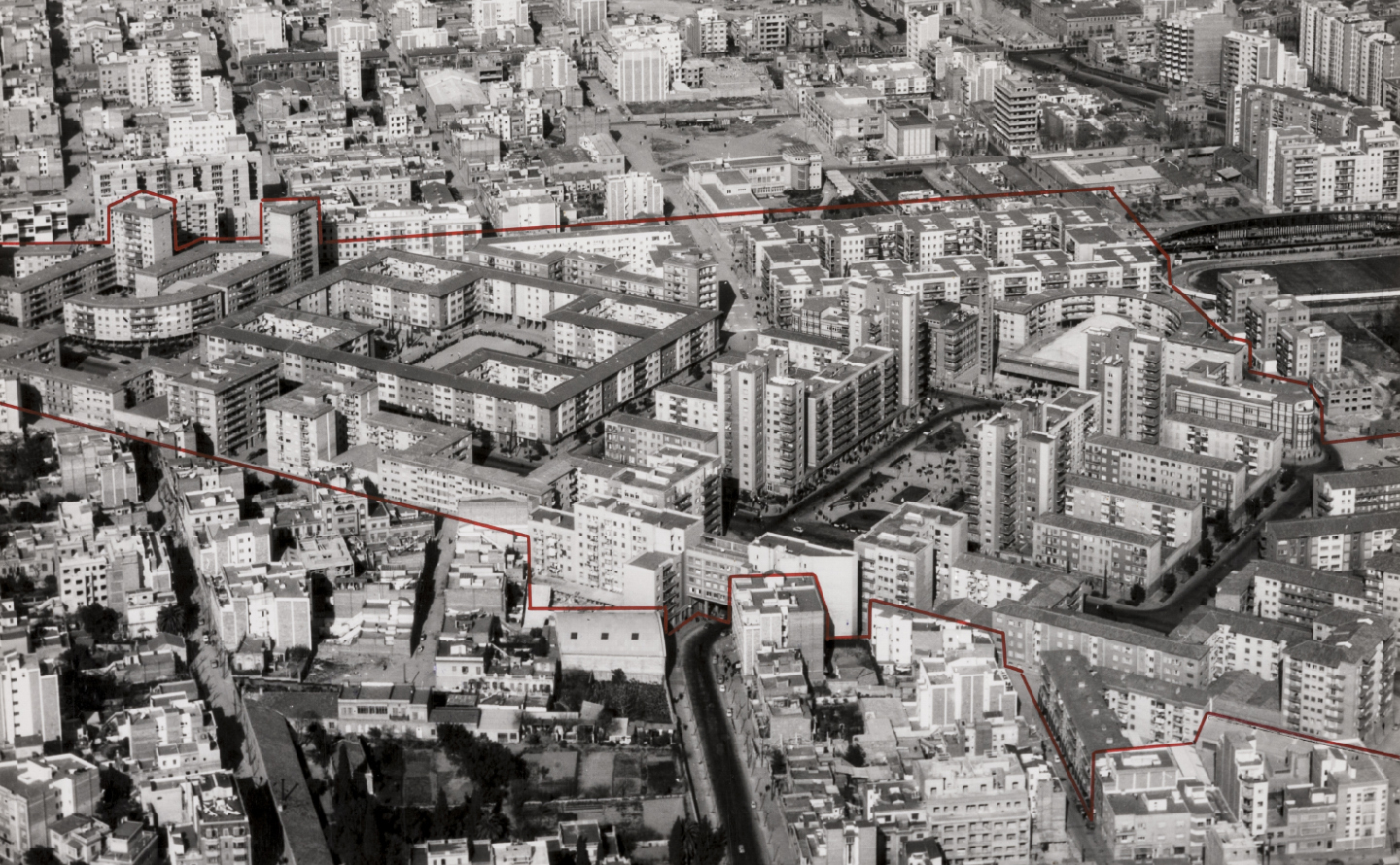 Vista aèria del barri amb perímetre delineat en vermell. Per article de D.Mackay a la revista Cuadernos de Arquitectura y Urbanismo n. 61. TAF, c.1962. Fons Quaderns d'Arquitectura i Urbanisme, Arxiu Històric del COAC
Congrés Eucarístic Housing. 1952-1962
Architects: Josep Maria Soteras, Carlos Marques and Antoni Pineda
Location: Pl. del Congrés Eucarístic, s/n
On the occasion of the International Eucharistic Congress of 1952, the Bishop of Barcelona launched a request for funding to put together the capital to build houses that would help to address the critical lack of housing in Barcelona. Government cooperation was obtained in the form of a mortgage to cover 40% of the costs, interest-free and repayable over 50 years, along with cooperation from local savings banks, which offered a mortgage for another 40%, at 4% interest and repayable over 20 years. As a result, individual contributions could be cut down to 20%, payable upon occupation. The government loan has now been replaced by a direct subsidy of 30,000 pesetas per unit, given fulfilment of the conditions stipulated in the Law on “Limited Income: Subsidies”. When the apartments are sold at cost, the funds from the initial capital are redirected into new developments, thus ensuring the ongoing construction activity of the institution.
The main activity of this institution has been concentrated in the suburb north of Barcelona known as Can Ros, but which has now been given the popular name “Congrés Housing”. The plot covers a total of 16.5 hectares. Between 1953 and 1962, 2,719 housing units were built, including housing for concierges, 306 shops with adjacent housing and 27 storehouses, two nurseries for 500 children, two single-gender secondary schools – one for boys and one for girls, each for about 800 to 1,000 students, a healthcare centre, a small residence for young workers, the parish church, a small football pitch, and various play areas for children. To finance the buildings for public services, all the commercial properties were sold by the institute at their market value. This kept the initial funds free for the construction only of blocks of flats. Currently the total population residing there is around 17,000 people, which results in a density of more than 1,000 inhabitants per Ha.
Cuadernos de arquitectura, no. 61, pp. 17-21, 1965.